

Reflections from Study visit TCA-event in Estonia and Finland

The international learning event took place 10-13 February inTallinn and Helsinki and was organised within the frameworkof the Erasmus+ Long Term Activity Digital Pedagogy in the Age of AI.
 EE01
EE01“The difficult questions are not technical”. Educators reflect on the future of learning in the age of AI
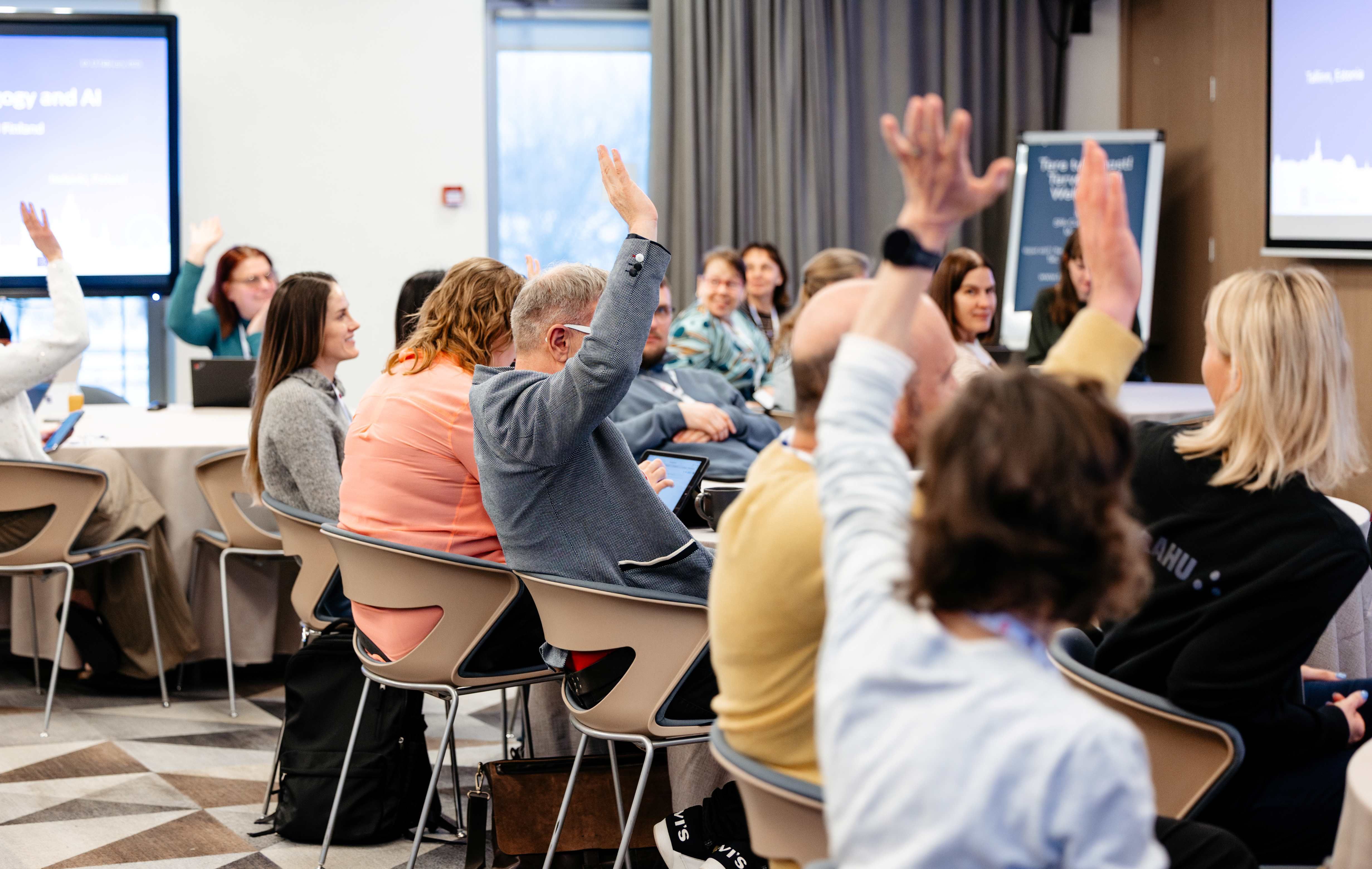
AI has pushed European schools into a place where familiar answers no longer work. Today, the hardest questions are not about tools or platforms, but about the very purpose of learning itself.
This is not just a technological change, but an epistemic shift: our understanding of knowledge, learning, and thinking is changing. As knowledge creation becomes increasingly collaborative between humans and AI systems, educators must rethink pedagogy, learning goals, and assessment.
What does it mean to learn in an age when answers are instantly generated? How should learning be assessed? And do grades still make sense in the same way they used to?
“These questions are not technical. They are pedagogical,” said Jaana Mihailišina, educational technologist and physics teacher at Tartu Raatuse School. “Why do we have to reinvent the wheel for AI? In many ways, it is still digital competence, just on another level. The real challenge is how we rethink teaching and learning as a whole.”
These thoughts framed a four-day Erasmus+ international training and cooperation event held in Tallinn and Helsinki, which brought together school and vocational education experts from across Europe.
As part of the Long-Term Activity Digital Pedagogy in the Age of AI, participants explored Estonian and Finnish digital pedagogy approaches through school visits, expert input and discussions on the challenges AI poses to everyday teaching practice.
A shared challenge, not a national one
European education systems may look different on paper, but when it comes to AI, teachers across Europe are facing the same uncertainty, time pressure and unanswered questions. No one really knows what the right way forward looks like.
“There is no success story yet,” stated Indrek Lillemägi, principal of Pelgulinna State Upper Secondary School in Tallinn. “We are all dealing with this messy situation together. There are no clear answers, but AI is not going away, so we must learn how to function in that messy world.”
Teacher training in AI and digital pedagogy is developing in many countries, but mostly in small steps. Guidelines are being drafted, pilot trainings are starting, and schools are experimenting, often without much time or support.
Time, in fact, has been mentioned again and again as the biggest obstacle.
“Teachers simply do not have it,” Lillemägi noted. “And we have not found anything we can realistically stop doing either.”
First-hand experience from Estonia and Finland
During the event, participants explored how digital pedagogy and AI in education are approached in Estonia and Finland, including visits to schools and vocational education institutions.
Maarit Kolehmainen, an English and French teacher from Finland, observed that Estonia has chosen a more coordinated nationwide approach to AI in education, while Finland leaves much of the decision making to municipalities and teachers.
“In Estonia there is a clear national direction,” she said, referring to Estonia’s AI Leap initiative and the established role of educational technologists in the school system. “In Finland, teachers and local authorities find their own solutions. Both approaches have their strengths and limitations. But this experience has genuinely inspired me. I am already planning how to start conversations about building stronger collaboration around teaching and learning in my own school.”
Dorine Schilperoort, deputy principal of Da Vinci College Kagerstraat in the Netherlands, was also inspired by the visits. “During the school visits in Estonia and at the Innokas Network at the University of Helsinki, it became clear to me that AI education does not have to start with technology. You can teach the logic behind AI in very simple ways, even without computers. That is something we could definitely take back to our own schools,” Schilperoort noted.
“My biggest worry is that students do not learn how to judge whether what they get from AI is actually true. We should be teaching how AI works, not just how to use it,” she said.
It’s a "Wild West” situation
The risk several participants noted is not technological, but pedagogical. Superficial learning risks reducing critical thinking and increasing overreliance on automated outputs.
“Teachers are not in danger of being replaced by AI,” Indrek Lillemägi said. “Students are, if they lose the ability to learn independently.”
Participants agreed that learning skills and self regulation have become more important than ever. At the same time, expectations keep rising while answers remain temporary.
“If you think you have found the right answer this year, it will probably be outdated next year,” Lillemägi added. “We also need to learn how to cope with the feeling that everything is a bit chaotic, because that is the reality right now.”
This view is shared by Jaana Mihailišina. “What I’m seeing everywhere is a kind of “Wild West” situation. Everyone understands there’s a problem, but no one quite knows where to start. And when people do start, everyone does it differently. In a way, it’s kind of cool—like yeast or bacteria spreading, with things growing in all directions.”
Moving forward together
Despite the uncertainty, the event underlined the value of learning from one another. Seeing how others experiment, question, and sometimes struggle, helps educators move forward, even without clear solutions.
“The main thing that stood out for me was that we are not alone,” said Mark Meijering, team manager of educational policy officers at Landstede in the Netherlands. “This is clearly a European wide issue. Everyone is trying to figure out how to deal with AI in schools,” he noted.
“It is okay not to have everything figured out. We are learning as we go and events like this help us realise that struggling is part of the process. You cannot do this alone,” Mark Meijering stressed. “We really need each other.”
About the event
The international learning event took place 10-13 February in Tallinn and Helsinki and was organised within the framework of the Erasmus+ Long Term Activity Digital Pedagogy in the Age of AI.
Participants from Italy, Hungary, the Czech Republic, the Netherlands, Luxembourg, Finland, Estonia, Malta, Latvia, Lithuania, Poland and Germany took part in discussions, school visits and joint reflection sessions focusing on AI in digital pedagogy and future skills in both school education and vocational education and training.
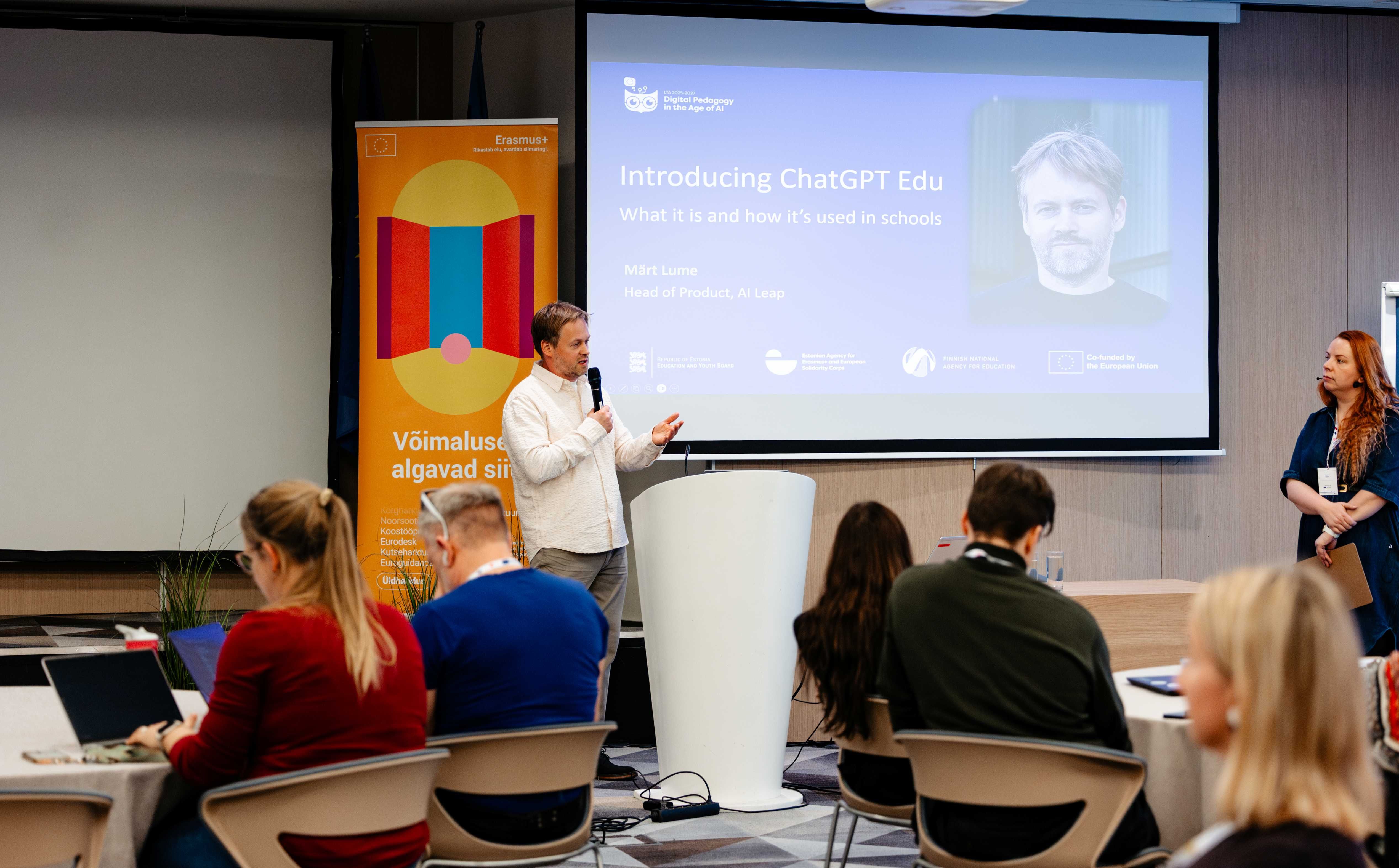
Expert presentations offered insight into the Estonian AI Leap initiative and early experiences of using generative AI tools in schools, complemented by reflections on lessons learned so far.
Photo credits: Karolin Viikoja, Source: Flickr
Read the original article here